
How Long Does It Take to Burn Out? 4 Benefits of Mindfulness for Prevention and Relief
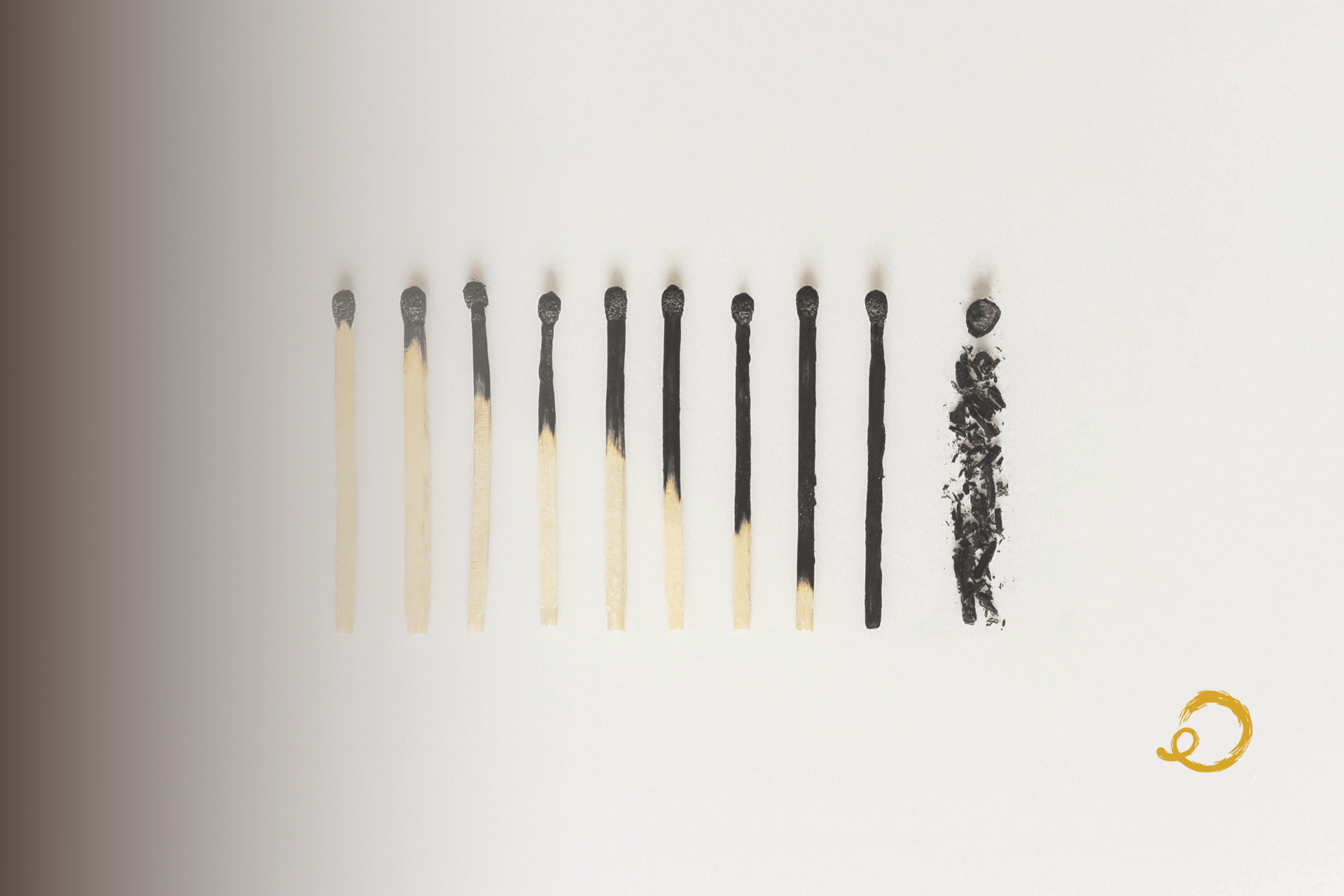
A month, two… maybe a year?
Ever since I spoke publicly about my own experience with professional burnout, I’ve been asked this question many times. Even though several years have passed since then—and despite many evenings spent reflecting on its causes—I still don’t have a simple, clear answer.
The same goes for symptoms. The obvious ones—the ones that pushed me to finally seek help—were impossible to ignore. But the more subtle ones? The small warning signs that, if noticed, might have protected me from the bigger crash? Those were much harder to catch.
So, can we actually protect ourselves from burnout? And could mindfulness play a role here?
“Burnout Is Taking Its Toll”
That’s a headline I recently read in a newspaper. The article referred to research suggesting that 8 out of 10 employees are at risk of experiencing burnout. Exaggerated? Not really.
Both the WHO and the ILO have been calling for concrete action to address mental health issues such as burnout, anxiety, and depression. Their warning is clear: if these challenges are not addressed properly, the consequences will only grow more severe.
The financial cost alone is staggering. Some reports estimate that burnout costs businesses $322 billion annually in turnover, absenteeism, and reduced performance (Workhuman). And that’s without even mentioning the emotional and human cost.
What Exactly Is Burnout?
According to the WHO, burnout is not classified as a disease but as an occupational phenomenon caused by chronic stress in the workplace. It is characterized by three dimensions:
- Feelings of exhaustion (physical and emotional fatigue, hopelessness, lack of energy).
- Increased mental distance or cynicism toward work (indifference, sarcasm, criticism, even sabotaging tasks).
- Reduced sense of accomplishment (low satisfaction, little sense of impact, decreased effectiveness).
Physically, it can manifest as sleep problems, headaches, muscle pain, digestive issues, and difficulty breathing. Emotionally and behaviorally, it shows up as low mood, irritability, hopelessness, emotional distance—or even total numbness.
What Do Canaries Have to Do with Burnout?
The causes of burnout, as highlighted by anti-burnout expert Aleksandra Kulga (with whom I recently spoke in my podcast Dobre rozmowy), are still primarily found in toxic work environments. Overload, constant pressure, unfairness, lack of recognition, unequal treatment, or conflict of values—not individual weaknesses—are the real drivers of burnout.
In this context, the leading researcher in the field, Prof. Christina Maslach, compares employees experiencing burnout to the canaries in coal mines at the start of the 20th century.
Why this comparison? Canaries are far more sensitive than humans to toxic gases in the air. When gas levels in the mine became too high, the birds would lose balance or even die, signaling danger to the miners.
Would it make sense to blame the canaries for their condition?
Of course not. And the same, according to Prof. Maslach, applies to employees. Burnout is not their personal fault—it’s a sign of toxicity in the system.
4 Mindful Ways to Respond
That’s why the main solutions for preventing burnout need to happen at the organizational level. The good news is more and more companies are working with experts to educate and raise awareness among employees. Still, it’s just a drop in the ocean, and we’re only at the beginning of this journey.
But what about at the individual level? Could taking care of our own resources—wherever possible—make a difference?
Yes. It won’t solve the systemic issues, but it can help us manage stress and the challenges of today’s workplace better. And here, mindfulness has a lot to offer. Research shows it can serve both as prevention and as intervention.
How does it work? Let me share just four reasons:
 Lower stress.
The most well-known effect of mindfulness is stress reduction. Regular practice decreases activity in the amygdala (the brain’s fear center) and strengthens connections with the prefrontal cortex, responsible for emotional regulation and decision-making.
Less negative thinking.
Mindfulness teaches us to step back from thoughts—especially negative, automatic ones—breaking the vicious cycle of stress and stopping the mental hamster wheel.
Early-warning system.
Mindfulness helps us notice the subtle signals the body sends before things escalate into crises. Small symptoms get spotted earlier, giving us a chance to act.
Side effect: rest.
While rest isn’t the main intention behind the mindfulness practice (the focus is simply being present with whatever arises), it often emerges as a powerful side effect. Taking a break from worrying, planning, or replaying the past frees up huge amounts of mental energy, naturally leading to better recovery and regeneration.
Mindfulness-based tools, especially MBSR (Mindfulness-Based Stress Reduction), are already widely used to support both individuals and organizations.
Why? Because the effects are measurable. Research shows significant decreases in burnout levels—particularly in emotional exhaustion—with moderate to strong effect sizes (e.g., Luken & Sammons, 2016). Other studies found perceived stress reduced by more than 30% (e.g., Klatt et al., 2009).
Impressive, isn’t it?
If you’d like to learn more about burnout and the positive impact mindfulness can have in navigating it, I invite you to explore the practice yourself—consistently, not only in times of crisis.
And if you’d like support in bringing mindfulness into your life or organization, feel free to reach out—I’d be glad to share more.
Przeczytaj więcej na podobny temat:
Is Seven a Lot? A Look at the 7 Types of Rest
You can live without rest – sure. But what kind of life is that, really?
It’s definitely not how nature intended it. Every living thing follows a rhythm of activity and recovery. Except us humans… we keep trying to skip the recovery part. And well, the consequences? We’ve all seen them.
When Sleep Isn’t Enough: Managing Your Energy in Stressful Times
Some studies suggest that during stressful situations, we burn through up to 35% of our energy—almost twice as much as in “normal” circumstances. So, can we really talk about energy management without bringing stress into the conversation?
The Art of Rest: Why We Need It More Than Ever
I took a hard look at my daily habits. And I realized that among all my “good” activities, one crucial element was missing: recovery. Now, I’m not talking about sleep—that’s a biological necessity. Chronic sleep deprivation can literally kill you. But rest—as in intentional mental and physical recovery—isn’t just a luxury. It’s essential.


0 Comments